

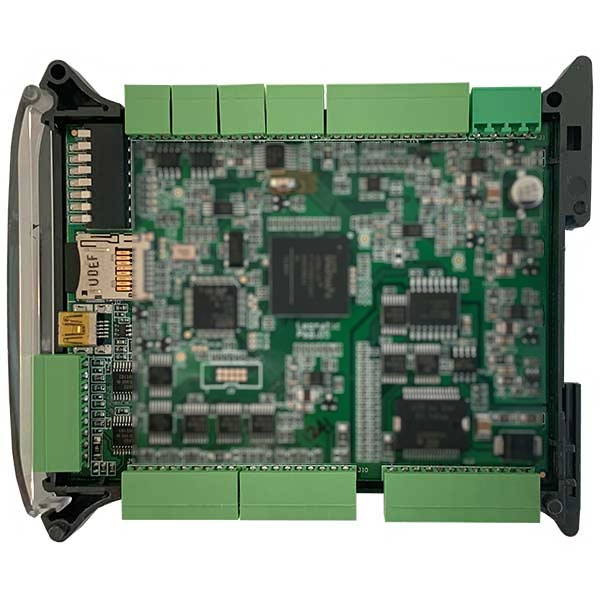
P.A.C. P68
Programmable Automation Controller up to 3 axes for servo or stepper motors, equipped with
Fast digital I/O (up to 10 In and up to 8 Out)
Analog I/O (up to 4 In and up to 6 Out).
Fast digital I/O (up to 10 In and up to 8 Out)
Analog I/O (up to 4 In and up to 6 Out).
The LEOMATIC P68 is a PAC (Programmable Automation Controller) that can manage up to 3 axes, each of servo (Brushless/DC/AC-inverter) or stepper (stepper) type.
All the functionality of a CPU, a PLC with integrated analog and digital I/O, and a high-performance motion controller are concentrated in a single device.
It has dedicated inputs for acquiring 3 incremental encoders, which can be used as physical axis feedback, as auxiliary position control also for stepper axes, or as master axis for synchronized movements.
Analog (+/- 10 V) or digital (differential or single-ended +5 Vdc) control signals to drives.
The motion control implements PID + Feed-Forward algorithms in velocity and acceleration and allows execution of continuous (Jog) and positional (GoTo) movements and Electric Axis (Gear) or Electronic Cam (Cam) activities with respect to an axis declared as machine master (physical or virtual), as well as multi-axis ISO Interpolations.
It is equipped with fast digital I/O (up to 10 In and up to 8 Out) and analog I/O (up to 4 In and up to 6 Out). It is still possible to expand the I/Os by connecting other Leomatic modules.
The P68 has mass storage on microSD to store configuration, data, recipes, PLC logic and for any on-board Firmware upgrades.
The provision of communication ports allows connection to external devices (PCs, Operator Panels, other PLCs, ...).
The possibility of connection with modules of the Leomatic System5 and System6 families is provided.
The presence of a CANopen port (with DS301 and DSP402 protocols) allows inclusion in CANopen networks.
Leomatic provides a free software suite for Windows PCs, which includes technical manuals, programming examples and utilities (PncTool for module configuration, programming, testing and diagnostics; LAB for editing and testing PLC logic).
It is possible, upon request, to customize the user firmware and implement additional communication protocols to external devices.

P.A.C. P68
Brushless axis controlproduct information
- Multi-tasking operating system for managing:
- User programmable PLC logic (PLC task);
- High-performance motion control (CNC task);
- removable mass storage (microSD) to house data, parameters (recipes, machine data) and PLC logic;
- Access to microSD from PC, in mass-storage mode;
- Retentive data retention in buffered memory;
- Clock and calendar functions;
- connection with external devices (PCs, Operator Panels, other PLCs, Printers, ...) via selectable protocols: proprietary LEOMATIC or standard (CANopen, ModBus RTU-Slave, MewToCol);
- Advanced testing and diagnostic functions, which can also be executed run-time in the field, for efficient service interventions:
- PLC logic program tracing;
- Monitoring and forcing a settable set of variables (Watch & Force tool);
- Graphical display of a settable set of variables (oscilloscope and microscope instruments);
- Self-test of power supply and internal voltages.
- Upgradability of on-board firmware via service PC or by simply uploading it to microSD.
- Configuration, testing and fine-tuning operations can be carried out quickly using special software tools for Windows PCs, provided free of charge.
- Programmability of motion control parameters, including:
- Sampling time, from 100 μs to 4 ms;
- presence and type of encoder;
- transmission ratio;
- position modularity for periodic axes;
- Polarity and search direction of the reference micro;
- Forward/reverse position limits (software end-stroke);
- maximum speed and acceleration;
- ...
- Position, velocity, acceleration, and deceleration of axes on 32-bit registers.
- Ability to increase internal count resolution by a factor of 4, 16, 32 or 64.
- Position-based axis control with parameterizable PID + Feed-Forward algorithms in speed and acceleration.
- Self-calibration on reference micro and/or encoder zero pulse, even at maximum speed.
- Performing continuous (Jog) or positional (GoTo) movements and Electric Axis (Gear) or Electronic Cam (Cam) activities with respect to an axis declared as master (physical or virtual), as well as multi-axis ISO Interpolations.
- Ability to vary on-the-fly the main kinematic and control parameters both from internal PLC logic and from outside (PC, Operator Panel, ...) even with moving axes.
Hardware
- ARM-CORTEX M4 microprocessor + FPGA
- Memory equipment:
- 64 Kb for PLC logic program execution;
- mass storage (microSD) to house configuration, machine-data, recipes and PLC logic;
- Rechargeable, long-life backup battery for maintaining 4 Kb of retentive data and clock/calendar.
- Control of 3 servo/stepper axes + 1 virtual axis in 100 μs.
- Control outputs to drives on dedicated terminal blocks:
- Analog: +/-10 V or,
- Frequency and Direction or,
- PhaseQuadrature.
- Frequency output:
- Up to 10 Mhz, single-ended or differential type;
- Pulse width: 30 μs up to 16 KHz, with duty-cycle of 50% above 16 KHz.
- Up to 10 fast (20 KHz), isolated digital inputs.
- Up to 8 fast, isolated digital outputs with output stages protected against short-circuits, over-temperature, external field power inversion.
- Up to 4 analog voltage inputs, with 0...+10 V range.
- Up to 6 analog voltage outputs, with +/- 10 V range.
- +10 Vdc power supply available on the analog I/O terminal block.
- 3 inputs for incremental encoders (up to 10 MHz) with single-ended or differential zero signals and pulse (line-driver type).
- +5 Vdc power supply available on each encoder terminal block.
- Reference micros for axis calibration that can be connected directly to on-board digital inputs.
- Two serial ports (one RS232 and one RS485) with selectable protocol for connection to external devices.
- One CANBus port with proprietary LEOMATIC protocol, for connection to LEOMATIC System5 / System6 modules.
- One CAN port with CANOpen protocol (DS301/DSP402).
- A USB port for connection with external devices (PC, Operator Panel, Service PC, Printers, ...) and/or access to microSD in mass-storage mode.
Electric
- Single power supply: +24 Vdc nominal (min. +15 Vdc, max. +30 Vdc).
- Power consumption: 120 mA max on +24 Vdc.
- Operating temperature: 5 °C to 65 °C.
- Over-temperature protection (max. 90 °C).
- Analog I/O:
- Up to 4 voltage inputs: range 0....+10 V.
- Up to 6 voltage outputs: range +/- 10 V. - Digital I/O:
- Galvanically separated field power supply (+24 Vdc nominal);
- Up to 10 isolated inputs, PnP, +24 Vdc nominal;
- Up to 8 isolated outputs, PnP, +24 Vdc nominal (600 mA fan-out on each output).
Physics
- Module for quick mounting on DIN rail.
- Small size: 101 × 120 × 22.5 mm.
- Inspectable front for access to microSD memory and dip-switches.
- 1 USB port (mini-B connector).
- 1 slide connector to accommodate a micro-SDmemory.
- A bank of 4 dip-switches for quick configuration of the device.
- Sectional terminal blocks with spring-loaded connection for communication and field ports (motors, encoders, I/O); with screw connection for power supply.
- 6 signalling leds to monitor the status of the control section and communication activities.
LEOMATIC provides free software components and tools/utilities for complete management of the P68 module. This equipment enables: configuration, PLC, machine data and recipe programming, test and diagnostic functions (also executable run-time in the field).
Different levels of software components are available, depending on the need to be met:
- Object-oriented libraries in DLL-MFC format for developing dedicated applications in MS VISUAL C++.
- ActiveX components for developing user applications from any environment that supports their use (MS VISUAL C++, VISUAL BASIC, VBA, LAB-VIEW, DELPHI, ....).
- Utility for configuration, diagnostics and programming of PLC logic, stand-alone and also sufficient for machine control if custom software is not needed.
